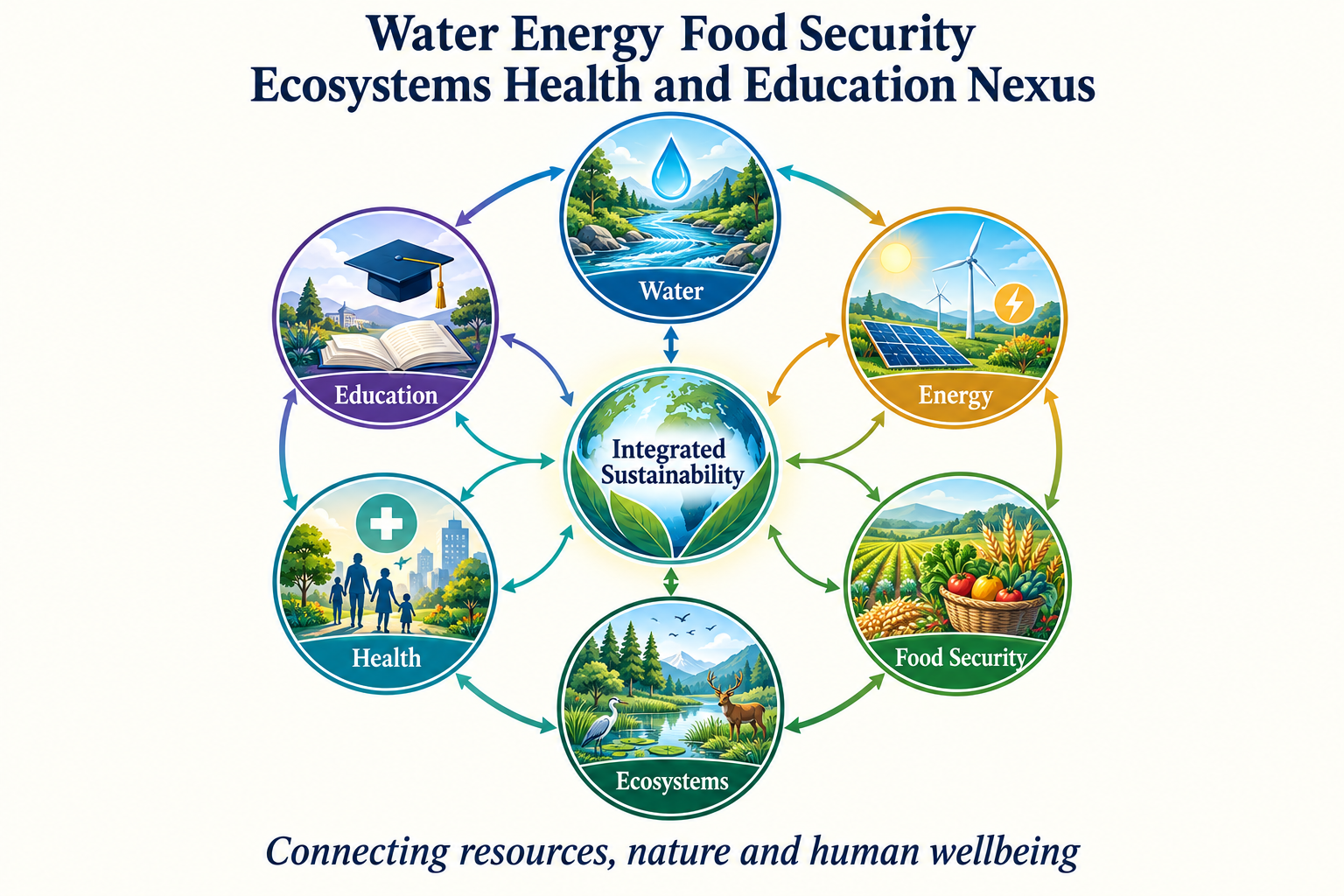
Integrated Thinking in Practice: Connecting Water, Energy, Food Security, Ecosystems, Health, and Education
السعر الأصلي هو: £500.00.£400.00السعر الحالي هو: £400.00.
الوصف
Description
Course Overview
Integrated Thinking in Practice: Connecting Water, Energy, Food Security, Ecosystems, Health, and Education provides participants with the knowledge and practical skills needed to understand connections between these sectors and develop coordinated responses to complex development challenges.
The course explores how decisions in one sector can create benefits, pressures, or unintended consequences in others. Participants learn to apply systems thinking, analyse interdependencies, assess trade-offs, and design interventions that support sustainable and inclusive outcomes.
Course Duration and Schedule (16 hours)
23-25 November 2026
The deadline is 19 November 2026
Learning Outcomes
By the end of this course, participants will be able to:
- Explain integrated thinking and its relevance to sustainable development.
- Identify connections between water, energy, food security, ecosystems, health, and education.
- Map relationships, feedback loops, and root causes within a selected development challenge.
- Assess potential benefits, trade-offs, and unintended consequences of proposed interventions.
- Explain how health and education influence—and are influenced by—resource management and environmental conditions.
- Engage stakeholders and establish priorities for coordinated action.
- Develop an integrated action plan with clear responsibilities and measurable indicators.
- Consider equity, community needs, and environmental sustainability when evaluating options.
Course Content
The course is organised around two units:
- Unit 1: Understanding Interconnected Systems—principles of integrated thinking, systems mapping, relationships between the six sectors, feedback loops, shared pressures, and limitations of isolated planning.
- Unit 2: Designing and Implementing Integrated Solutions—stakeholder engagement, analysis of intervention options, management of trade-offs, coordinated planning, monitoring, and development of a practical action plan.
The eight sessions cover:
- Introduction to Integrated Thinking: Systems thinking, sector interdependencies, and the value of coordinated approaches to development.
- Water, Energy, and Food Security: Connections between water supply, energy use, agricultural production, food access, and resource efficiency.
- Ecosystems and Resource Sustainability: Relationships between biodiversity, soil, catchments, ecosystem services, and productive activities.
- Health within Interconnected Systems: Links between water and sanitation, nutrition, energy access, environmental conditions, and community health.
- Education as an Enabler and Outcome: Connections between education, skills, resource management, health literacy, and community participation; how water, nutrition, and energy access affect learning.
- Systems Mapping and Stakeholder Analysis: Defining system boundaries, mapping causal relationships, identifying affected groups, and selecting opportunities for intervention.
- Integrated Planning and Evaluation: Comparing options, assessing trade-offs, coordinating responsibilities, and selecting indicators across sectors.
- Practical Project and Review: Presenting an integrated action plan, reviewing assumptions, and incorporating feedback.
Training Methodology
The proposed training approach combines:
- Online presentations: Tutor-led explanations of key concepts, supported by examples and discussion.
- Independent learning: Guided reading, study materials, quizzes, and reflection activities.
- Case studies: Analysis of challenges such as drought, irrigation choices, school water and energy provision, and community food security.
- Systems-mapping exercises: Visual exploration of connections, feedback loops, and potential unintended effects.
- Practical assignments: Stakeholder analysis, comparison of intervention options, and development of indicators.
- Assessment and feedback: Knowledge checks, review of assignments, and feedback on the final project.
Who Should Attend
This course is ideal for:
- Government officials, policymakers, and local authority staff.
- Professionals working in water, energy, agriculture, food security, or environmental management.
- Health professionals, educators, and community development practitioners.
- NGO staff, programme managers, and project coordinators.
- Sustainability professionals, researchers, and development planners.
- Individuals involved in initiatives requiring collaboration across sectors.
Certificate
The proposed course awards a Certificate of Completion from Bayt El-Maarifa International Academy, UK to participants who meet the attendance requirements, complete the required assignments, and successfully submit an integrated action-planning project.
Master the Skills to Build Your Future Today
Join over 10,000+ students already accelerating their careers. Get instant, lifetime access to all course materials and private community perks.


 Arabic
 English
المراجعات
لا توجد مراجعات بعد.