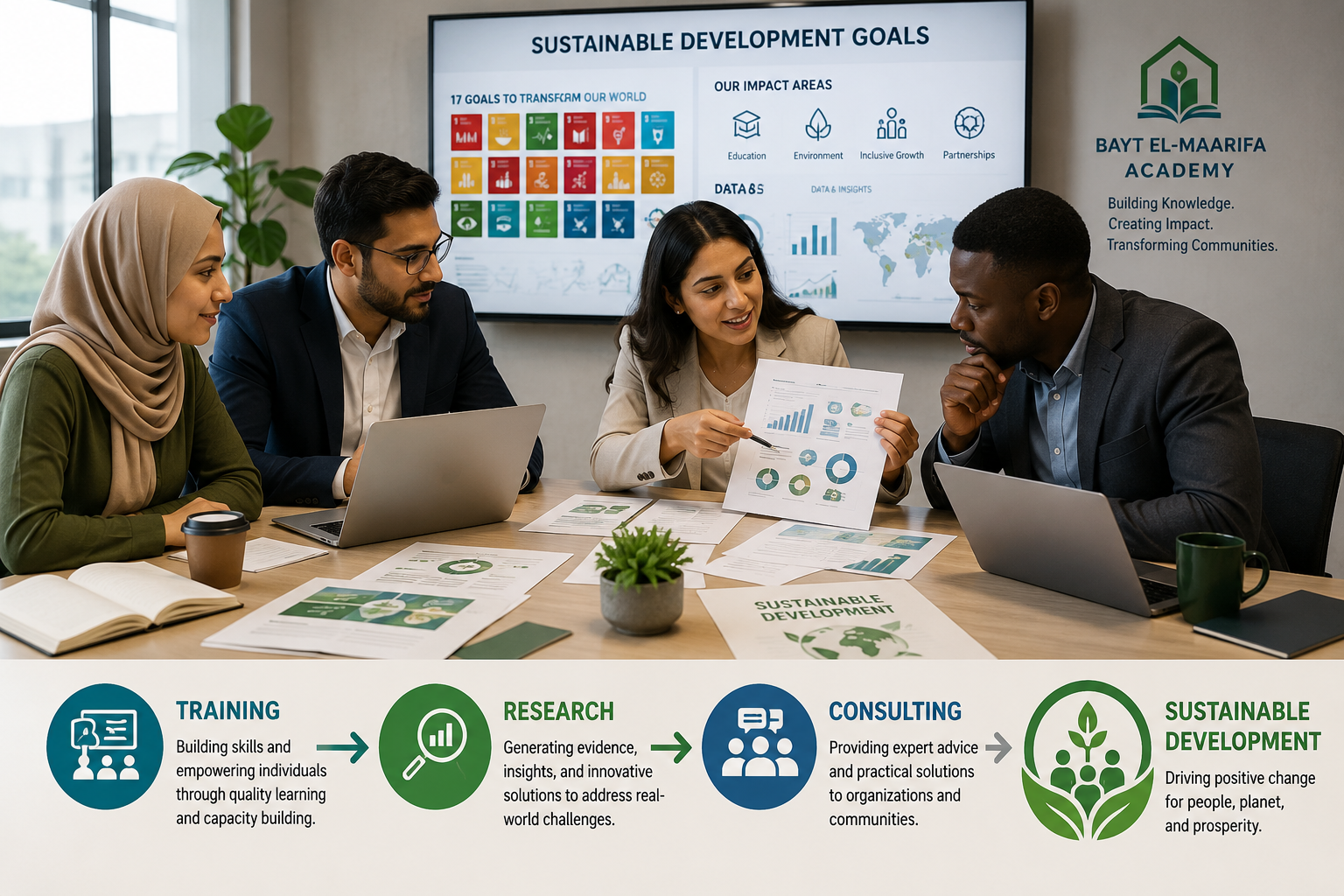
When organizations seek to expand their capabilities in sustainability, it becomes isolated activities: sending employees to different training programs, commissioning research as separate projects, and hiring different consulting firms. The cumulative effect of this is a surplus of disparate knowledge that seldom develops into any substantial change.
Unlike organizations that approach sustainability in this way, Bayt El-Maarifa International Academy (BIA) places their philosophy of sustainability at the heart of their operations. As a global organization based in the UK, (IBEA-UK) has successfully fused three core aspects of sustainability into a single facility: professional training, research, and consultancy. For government agencies that require consultancy for sustainable development, for NGOs that require training in the monitoring and evaluation, and for environmental organizations that require training in environmental governance, BIA provides an integrated system that links training with sustainable outcomes.
Three Pillars, One Vision
- Professional Training — Building Individual and Organisational Capacity
At the heart of BIA’s work is CPD-accredited professional training designed for practitioners, policy professionals, and development workers across the globe. The Academy’s training portfolio spans critical areas including:
- Monitoring and Evaluation (M&E) Training — Equipping development professionals with the frameworks and tools to design robust M&E systems, measure project impact, and report credibly to donors and stakeholders. This is particularly vital for NGOs, UN-registered partners, and government departments who must demonstrate accountability in programme delivery.
- Environmental Governance Training — Helping organisations understand the policy, legal, and institutional frameworks that govern natural resources, climate action, and environmental compliance. From ESG (Environmental, Social, and Governance) principles to ISO 14001 standards, BIA’s environmental governance training prepares professionals to lead responsible, compliant, and forward-thinking organisations.
- Sustainable Development Training — Covering the interconnected nature of the SDGs, water resource management, climate policy, and community resilience — BIA’s programmes ensure professionals understand sustainability not just as a concept, but as a practice they can implement immediately.
Training is delivered flexibly through classroom-based instruction, eLearning, blended learning, and on-the-job formats, making it accessible to professionals based in Manchester, across the UK, and internationally.
- Applied Research — Generating Knowledge That Drives Policy
Training without evidence has limited reach. That is why BIA does not stop at teaching — the Academy actively conducts and supports applied research that informs policy and practice in sustainable development.
BIA’s research work includes studies on the nexus between water governance and corruption in the Arab states, interlinkages between the Sustainable Development Goals, and programmes addressing the needs of women, children, and vulnerable communities in fragile and conflict-affected settings. This research is not purely academic. It feeds directly into consultancy engagements, training content, and donor proposals — ensuring that everything BIA delivers is grounded in evidence.
For organisations that need rigorous research outputs to support funding applications, programme design, or policy advocacy, BIA also provides research support services, including proposal development for international donors such as UNDP, UNICEF, UNFPA, and WFP.
- Sustainable Development Consultancy — Translating Knowledge into Action
The third pillar — and arguably the one that ties everything together — is BIA’s consultancy offer. Sustainable development consultancy at BIA goes beyond generic advice. Drawing on the Academy’s deep expertise in environmental governance, water management, ESG frameworks, and community resilience, BIA’s consultants work alongside organisations to co-design solutions, strengthen systems, and build long-term institutional capacity.
Key consultancy services include:
- Strategic advisory on sustainable development policy and programming
- Environmental governance assessments and compliance reviews
- M&E framework design and evaluation support
- Capacity-building programme design for governments and NGOs
- Donor proposal development and fund positioning
This consultancy work is backed by a team of internationally recognised experts — including professors, environmental management specialists, and climate policy advisors — who bring decades of field experience across Africa, the Middle East, Asia, and Europe.
Why Integration is Important
BIA’s three-pillar model is effective because of the following reasons: training directs research, research improves consultancy, and consultancy creates advanced training. Professionals who train at BIA gain certificates and tools designed with the help of recent research and empirical consultancy. The organisations that request consultancy from BIA gain the services of trainers and researchers who have practical knowledge of the challenges that exist.
For development professionals, NGOs, government agencies, and international organisations, this model provides something that is almost unavailable in the market — a single proven partner who can take an organisation from creating an individual skill to implementing organisation-wide, evidence-based, and systematic alterations.
Frequently Asked Questions (FAQ)
Q1: What type of organizations does Bayt El-Maarifa Academy collaborate with?
The Academy collaborates with international NGOs, UN agencies, ministries, environmental organizations, as well as corporate sustainability and ESG focused organizations. The Academy is registered with several UN agencies such as UNDP, UNICEF, WHO, UNFPA, and WFP.
Q2: Is the training CPD accredited?
Yes. BIA is a CPD accredited provider. Participants that complete the relevant training programs earn CPD credits that are recognized globally and are relevant for several sectors.
Q3: What is the content of monitoring and evaluation training at BIA?
BIA’s M&E training is oriented towards development practitioners and includes training on results frameworks, logical frameworks (logframes), as well as training on various methodologies for data collection and analysis, indicator development, and donor reporting.
Q4: What is environmental governance training and who is it for?
Environmental governance training at BIA focuses on understanding the management of the environment through the law, the institutions, and the policy avenues, and is designed for environmental officers, policy advisors, compliance managers, and sustainability leads in both the public and private sectors.
Q5: Can BIA provide bespoke consultancy for our organisation’s specific needs?
Yes. BIA’s sustainable development consultancy is designed with the specific context, sector, and strategic priorities of your organisation in mind. Please contact the Academy for further information.
Q6: Does BIA conduct research as well as deliver training?
Definitely. Research is one of BIA’s three core pillars. The Academy’s applied research focuses on water governance, the interlinkages of the SDGs, environmental policy, and community resilience and helps organisations to design programmes and develop funding proposals that are backed by solid evidence.
Q7: Where is Bayt El-Maarifa Academy based and does it work internationally?
BIA is located in Manchester, UK, and has a global reach. Training can be delivered in-person or online, and the Academy’s programmes and consultancy have been conducted throughout the Middle East, Africa, and beyond.
 English
  Arabic