You finish your monitoring and evaluation training. Certificate in hand. Skills in place.
And then comes the real question now what?
Honestly, most people never ask this before they enrol. They think about getting the qualification. They do not think about where it actually leads.
So let me tell you what most course pages will not.
M&E is not a back-office function anymore. It is not just about ticking boxes for donors or filling in log frames at the end of a project. Today, governments, NGOs, international agencies, and even private sector organisations need people who can look at a programme and say clearly, confidently, with evidence whether it is working or not.
That skill is rarer than you think. And it pays well.
What Monitoring and Evaluation Training Actually Teaches You
Look, there is a version of M&E training that teaches you to copy templates and generate reports. That is not what serious training looks like.
Good monitoring and evaluation training teaches you how to build a measurement framework before a programme even starts. It teaches you how to collect data that is reliable, not just convenient. It teaches you how to analyse what you find. And maybe most importantly it teaches you how to tell the story of that data to people who need to act on it.
That last part is where most M&E professionals fall short. The data is fine. The communication is weak.
At Bayt El-Maarifa International Academy, M&E training is part of the Project Management and Monitoring category. It is CPD-accredited and built around practical skills, not just theory you forget in three weeks.
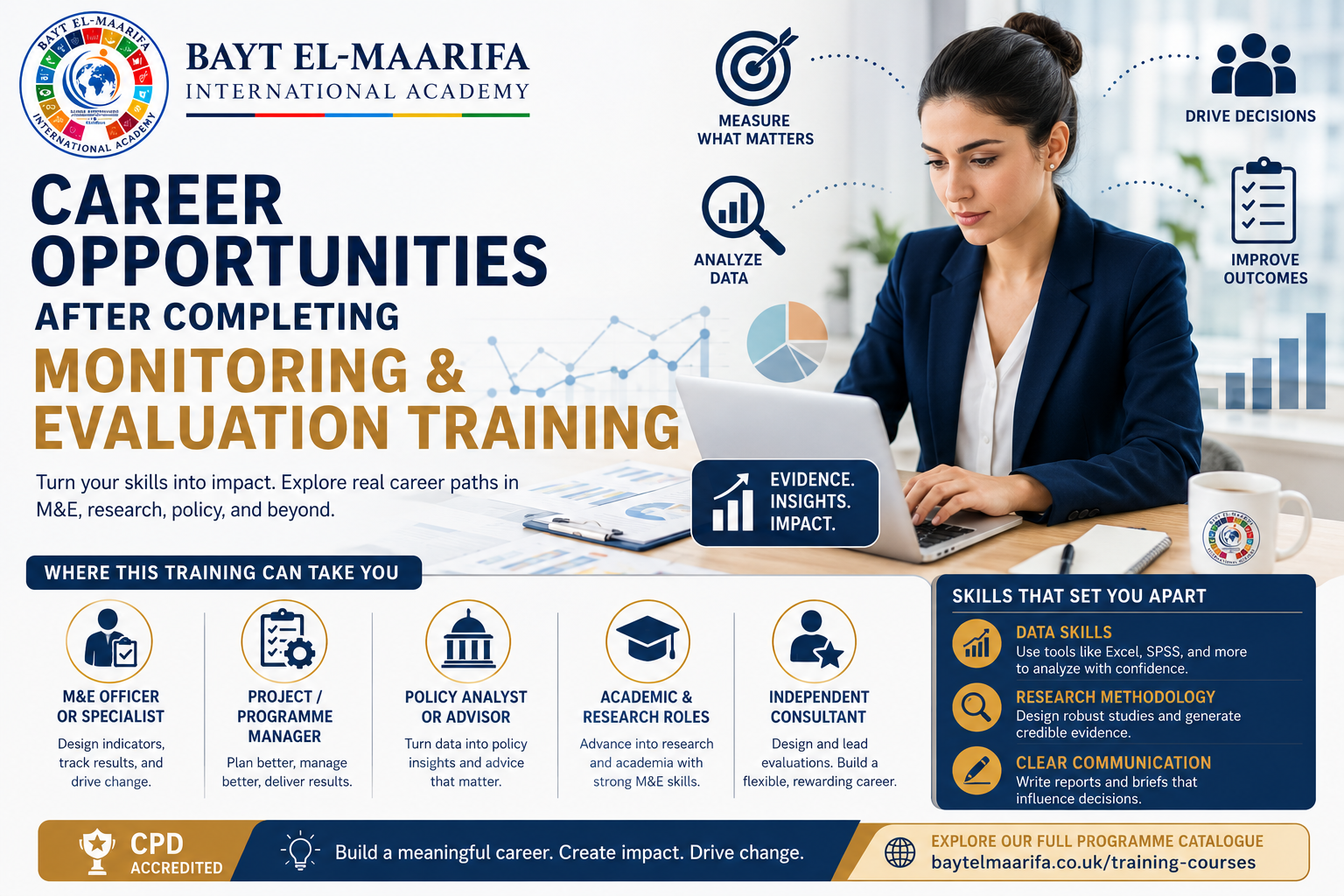
Where This Training Actually Takes You
M&E Officer or Specialist
The most direct path. NGOs, UN bodies, development banks, and government programmes all hire M&E specialists.
The job involves designing indicators, tracking results, running evaluations, and reporting to donors. It sounds like an admin. It is not. A strong M&E officer quietly shapes how resources move and how programmes change course.
Entry-level roles exist. So do senior ones. The ceiling is higher than people assume.
Project Manager or Programme Manager
Here is something not everyone realises. Monitoring and evaluation training is one of the best ways to move into broader project management.
When you understand how to measure results, you start to see how projects should have been designed from the start. That perspective is valuable. Combine M&E skills with something like PRINCE2 also available at Bayt El-Maarifa International Academy and you have a profile that stands out.
Policy Analyst or Advisor
Governments and institutions need people who can look at programme data and say what it means for policy.
This is where research methodology training comes in. An M&E professional who also understands how to design rigorous research not just collect data, but actually design a study can move into policy analysis, advisory work, and institutional research roles.
These are well-paid, high-impact positions. And they are genuinely hard to fill.
Academic and Research Roles
Some professionals use M&E as a stepping stone into research or academia. The skills overlap more than people think data collection, analysis, and evidence interpretation are core to both worlds.
If this is the direction you are heading, academic professional development matters. Bayt El-Maarifa International Academy offers research methods and skills training, thesis and dissertation writing, and academic writing and editing support. These are not extras. They are what make the difference between a professional who can do research and one who can do it well.
Independent Consultant
Experienced M&E professionals often go independent. Donors commission evaluations of large-scale programmes. If you can design and run those evaluations and you have a strong track record you can build a flexible, well-paid consultancy career.
It takes time to get there. But it is a real path.
The Skills That Separate Good From Great
Finishing monitoring and evaluation training is the start. What you build around it determines how far you go.
A few things that actually matter in practice:
Data skills. Most M&E work today involves data tools. At Bayt El-Maarifa International Academy, courses like IBM SPSS for Statistical Data Analysis and Excel for Business Statistics and Data Analysis sit alongside the core training. Professionals who combine these skills are simply more employable.
Research methodology. This is what separates someone who collects data from someone who knows what to do with it. Research methodology training gives you the analytical foundation to design evaluations properly not just report on what was gathered.
Writing clearly. Reports, evaluations, and policy briefs all live or die by how clearly they are written. This is where academic professional development is useful even outside academia. If you cannot communicate your findings, the findings do not matter.
Mistakes People Make With M&E Careers
Thinking it is only for NGOs
It is not. Corporate sustainability teams, government departments, public health bodies, and education institutions all run programmes. All of them need to know whether those programmes work. M&E goes wherever accountability goes.
Treating the certificate as the finish line
The certificate opens the door. The career comes from what you do after the roles you take, the tools you learn, and the projects you push yourself through.
Skipping the research side
The strongest M&E professionals are not just good at tracking, they are good at research design. They know why certain methods produce reliable results and others do not. Research methodology training is not an optional extra. It is what makes the work actually credible.
FAQs
Is monitoring and evaluation training useful outside the development sector?
Yes. Any organisation that runs programmes and needs to show results in health, education, corporate sustainability, or government needs M&E skills. The sector changes. The need does not.
How does monitoring and evaluation training connect to academic professional development?
More than people expect. Both require research design, data analysis, and clear communication. Professionals who build both are well-placed for roles in research, policy, and consultancy.
What is research methodology training and why does it matter for M&E work?
It teaches you how to design a study properly, choose the right methods, and interpret results correctly. Without it, you are collecting data. With it, you are producing evidence.
Can M&E training lead into project management?
Absolutely. Many professionals make exactly this move. M&E gives you a deep understanding of results-based frameworks, which is exactly what modern project management demands.
The Bottom Line
Here is the truth. Monitoring and evaluation training is one of the most practical investments you can make for a career in development, sustainability, or public policy.
But the career does not come from the certificate alone. It comes from building around it — the research skills, the data tools, the writing, and the willingness to keep going.
Bayt El-Maarifa International Academy puts all of this in one place. CPD-accredited, internationally relevant, and built for professionals doing real work in the real world.
If you are ready — start here.
👉 Explore the full programme catalogue at baytelmaarifa.co.uk/training-courses
 English
  Arabic